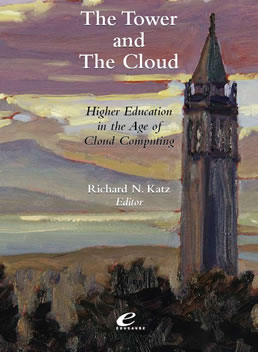
The link to “Readings” at the top of this blog page takes you to stuff I’m reading – however, so enthused am I by this recent publication, I decided it merited a post of its own. Cloud computing is the biggest new thing that will happen to IT departments in learning institutions for a long while. To get an overview and clear perspective of the issues I recommend The Tower and the Cloud.
The blurb reads:
“The emergence of the networked information economy is unleashing two powerful forces. On one hand, easy access to high-speed networks is empowering individuals. People can now discover and consume information resources and services globally from their homes. Further, new social computing approaches are inviting people to share in the creation and edification of information on the Internet. Empowerment of the individual—or consumerization—is reducing the individual’s reliance on traditional brick-and-mortar institutions in favor of new and emerging virtual ones. Second, ubiquitous access to high-speed networks along with network standards, open standards and content, and techniques for virtualizing hardware, software, and services is making it possible to leverage scale economies in unprecedented ways. What appears to be emerging is industrial-scale computing—a standardized infrastructure for delivering computing power, network bandwidth, data storage and protection, and services. Consumerization and industrialization beg the question “Is this the end of the middle?”; that is, what will be the role of “enterprise” IT in the future? Indeed, the bigger question is what will become of all of our intermediating institutions? This volume examines the impact of IT on higher education and on the IT organization in higher education.”
Read a pdf version of the book HERE
Using the WorldCat citation service the full bibliographic details are:
KATZ, R. N. (2008). The tower and the cloud: higher education in the age of cloud computing. [Boulder, CO], EDUCAUSE.
Filed Under (General) by elearning4bradford on 21-04-2009

A recent roundtable discussion about the future of Lifelong Learning in the current economic climate raises some interesting points. Sponsored by the Guardian newspaper the challenge was set out thus:
“With the country in the grip of a recession widely recognised as one of the worst in history, training has never been so important. For those working in lifelong learning and skills development there are big questions to tackle. In an increasingly uncertain economic climate, predicting what kind of training is required, and to what level, is a big challenge. With rising unemployment, should the emphasis lie with re-skilling or up-skilling? And should specific sectors take priority?”
A full report of the debate is available from the Guardian website
Reminds me that in 1997 when asked about his economic policy, Mr T. Blair stated “Education is the best economic policy we can have”.

Here are some podcasts that I have recently listened to which some may find interesting – accessed from the JISC website.
Here Sarah Thomas of University of Oxford and Robert Darnton Harvard University discuss the future of libraries
Here John Crawford and Christine Irving talk about Information Literacy as a ‘democratic right’
This final one, here, is a longer cast where OCLC Vice-President Karen Calhoun talks about the provision of digital content for learning and research.

A few days ago I visited Harlow Carr the RHS (Royal Horticultural Society) gardens near Harrogate. I was impressed with the library; there were about 4,000 volumes and an excellent range of magazines catering for the general hobbyist and the more specialist interests. The classification scheme used for the print stock was interesting a kind of supplemented Dewey integrated with plant classification schemes. The library, which is open daily, is run by a team of volunteers under the guidance of librarians based at the headquarters of the Lindley Library, in London. The library is currently housed in the Study Centre within the gardens.
However work has already started on a new building to facilitate the library collections and to extend the learning activity. The new building sounds incredibly exciting, having a zero carbon footprint it will be the greenest library in the UK. At a cost of £3m the facility will have a massive impact on learning; providing opportunities to schoolchildren and adults to understand the link between themselves and the natural world through horticulture.
From the Harlow Carr website “The learning centre will increase our capacity for free school visits more than threefold, enabling the garden to welcome more than 10,000 schoolchildren a year. It will also provide a base to expand our outreach programmes locally and in the wider region, to engage with hard-to-reach communities and schools. The project will also allow for a broader programme of educational workshops for all gardeners and visitors to Harlow Carr.”
I shall be following with interest the development of this new building. I picked up some seeds for my allotment from the very well-stocked shop – which, incidentally has an excellent book section particularly strong on botanical art books which included the recently published The Wild & Garden Plants of Ireland illustrated with 99 watercolour prints by the brilliant E Charles Nelson and Wendy F Walsh (2009 Thames & Hudson £25) which I regret not having purchased – but which would have certainly led to dreams of walks in Connemara and the Wicklow mountains – maybe next time!

The Yorrkshire and Humber JISC Regional Support Centre has brought out a publication that ties in with their event on March 11th at which I presented a paper about using Moodle as a virtual research envrionment.
“The substance of this paper gives a first-hand account of developing a virtual research environment and how scarce resources are deployed to accommodate a range of approaches while maintaining steady progress towards the realisation of enhanced pedagogy through using learning technology.”
Download the full report here
